
Riding the Ocean
tapping the power of the wind

‘To navigate you must be brave, and you must remember’
Mau Piailug, Micronesian navigator
There are only three sailing boats in the Gerupuk bay on the southern coast of Lombok in eastern Indonesia when we arrive - my son Sam’s trimaran Bengbeng, another owned by a New Zealander who visits regularly, and a third whose ensign I can’t quite make out. In the early morning, the bay hums with the phut-phut-phut of outboard motors of the fishermen going out in their homemade jukung boats. They surrendered their crabclaw masts and sails long ago.
But the best sound in the bay is the urgent tugging of the wind on the freshly unfurled genoa (headsail) of Bengbeng, when we cut the outboard, and head out of the bay into the open sea.
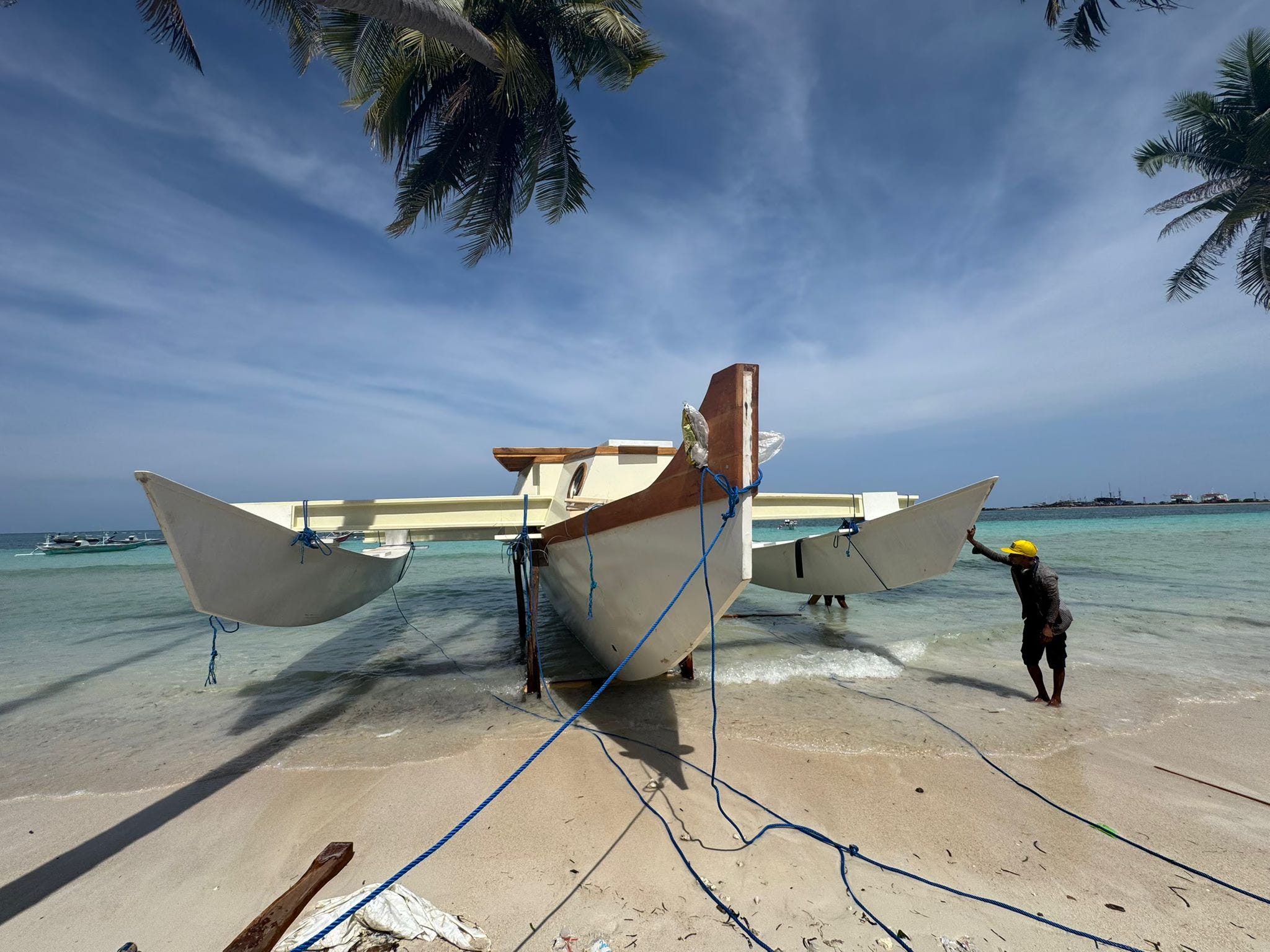
Launch day on Bira, 23.10.25
She’s a beautiful trimaran, 42 feet long, stable at sea and able to sail quite close to the winds which whip up each afternoon from the west and northwest at this time of year, but blow pretty strong all day too, beyond the headland. The design was adapted from a James Wharram (famous British boat builder) catamaran - a single main hull of plywood and fibreglass, suspended white teak decks, trimmed with red mahogany and teak. Wharram was inspired by the double-canoes of the Polynesians, and the use of outriggers, to give extra stability.
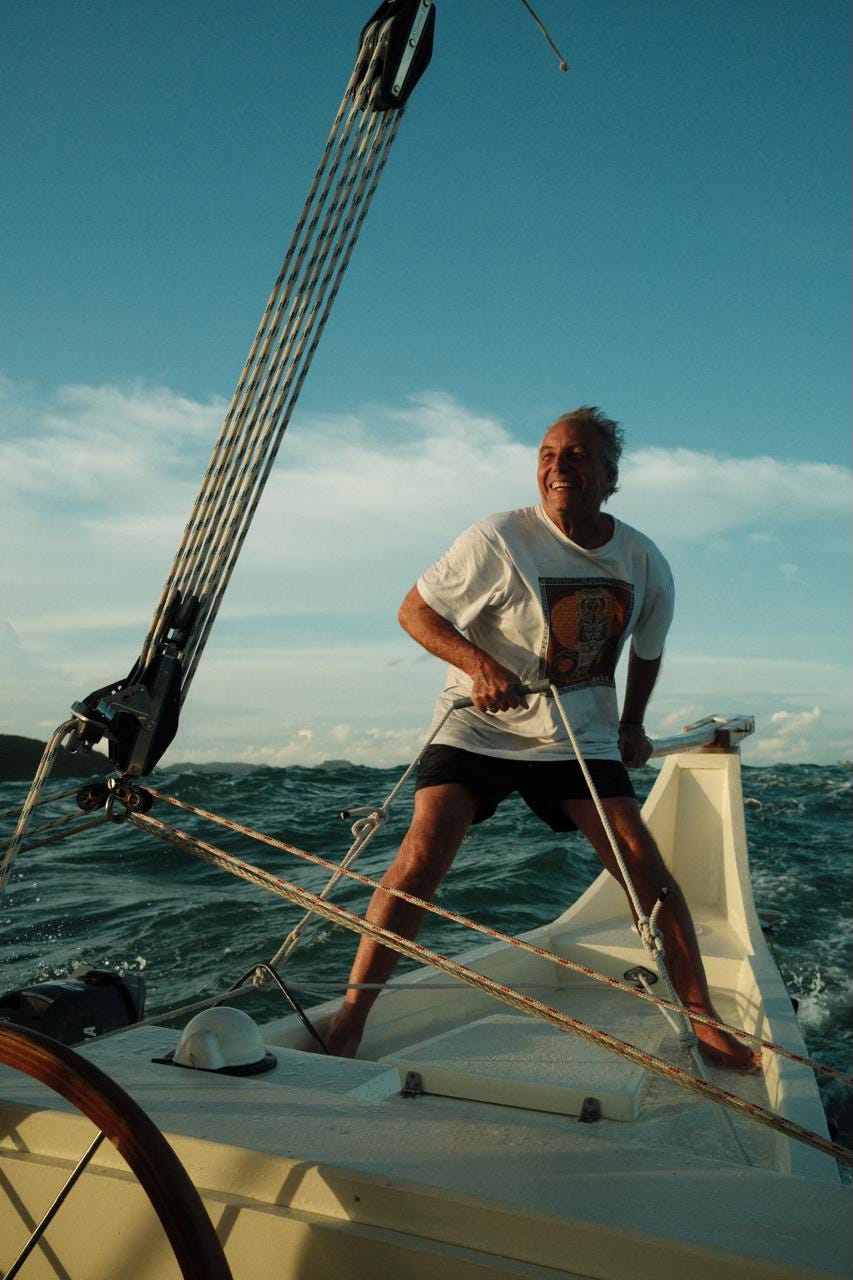
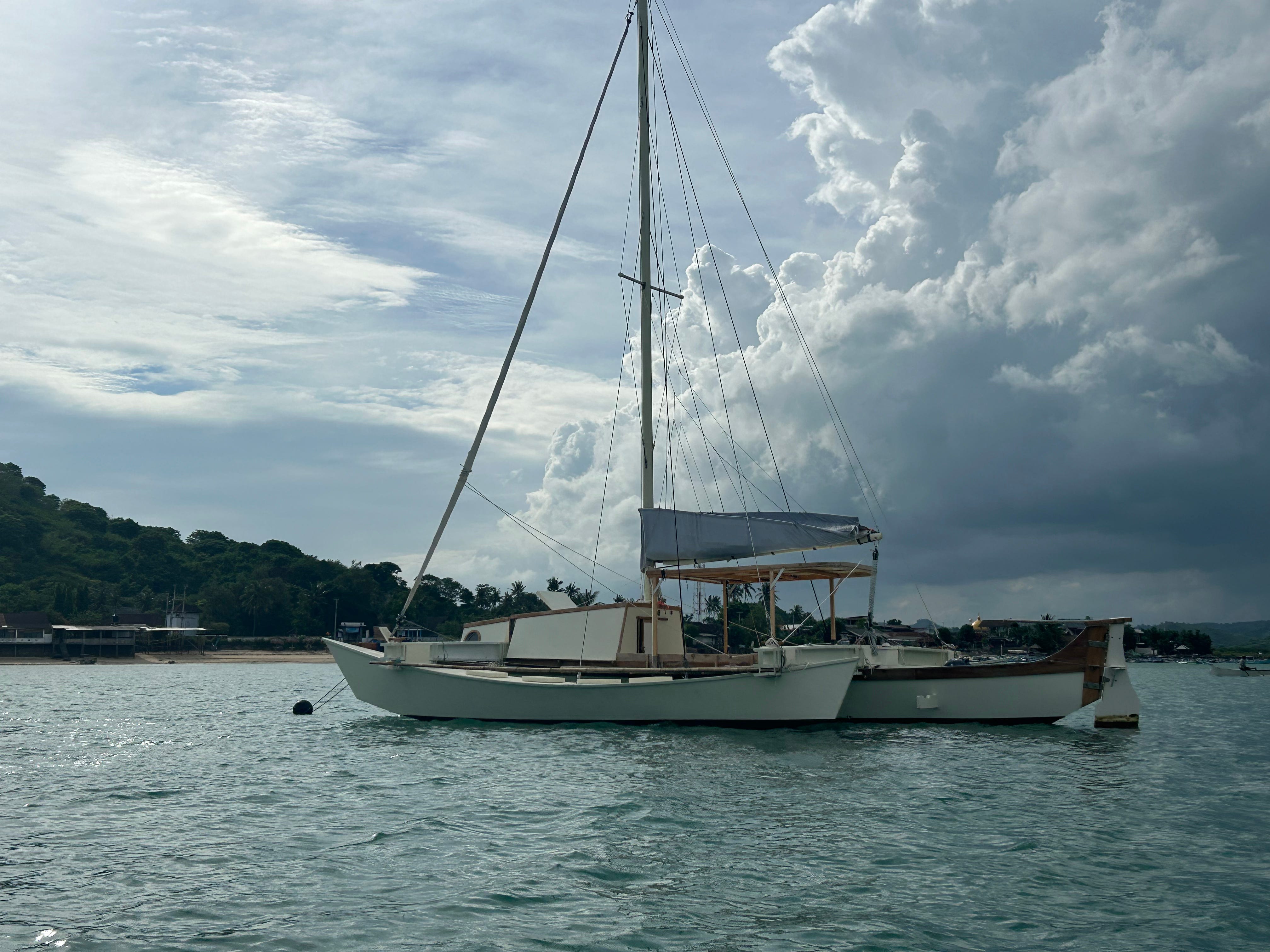
Bengbeng was built at Bira on the southern tip of Sulawesi. The main hulls were already finished when Sam and his friends took over the project. Instead of a second hull to make a Wharram catamaran, the boat got two outriggers instead.


She’s the only yacht of her kind on the vast blue expanse which covers the larger part of this magnificent marble, spinning through space. You can steer from the tiller at the stern, or the wheel in the cockpit. Because of the canopy - necessary for shade from the sun, shelter from squalls - there’s a better view of the sails from the tiller.
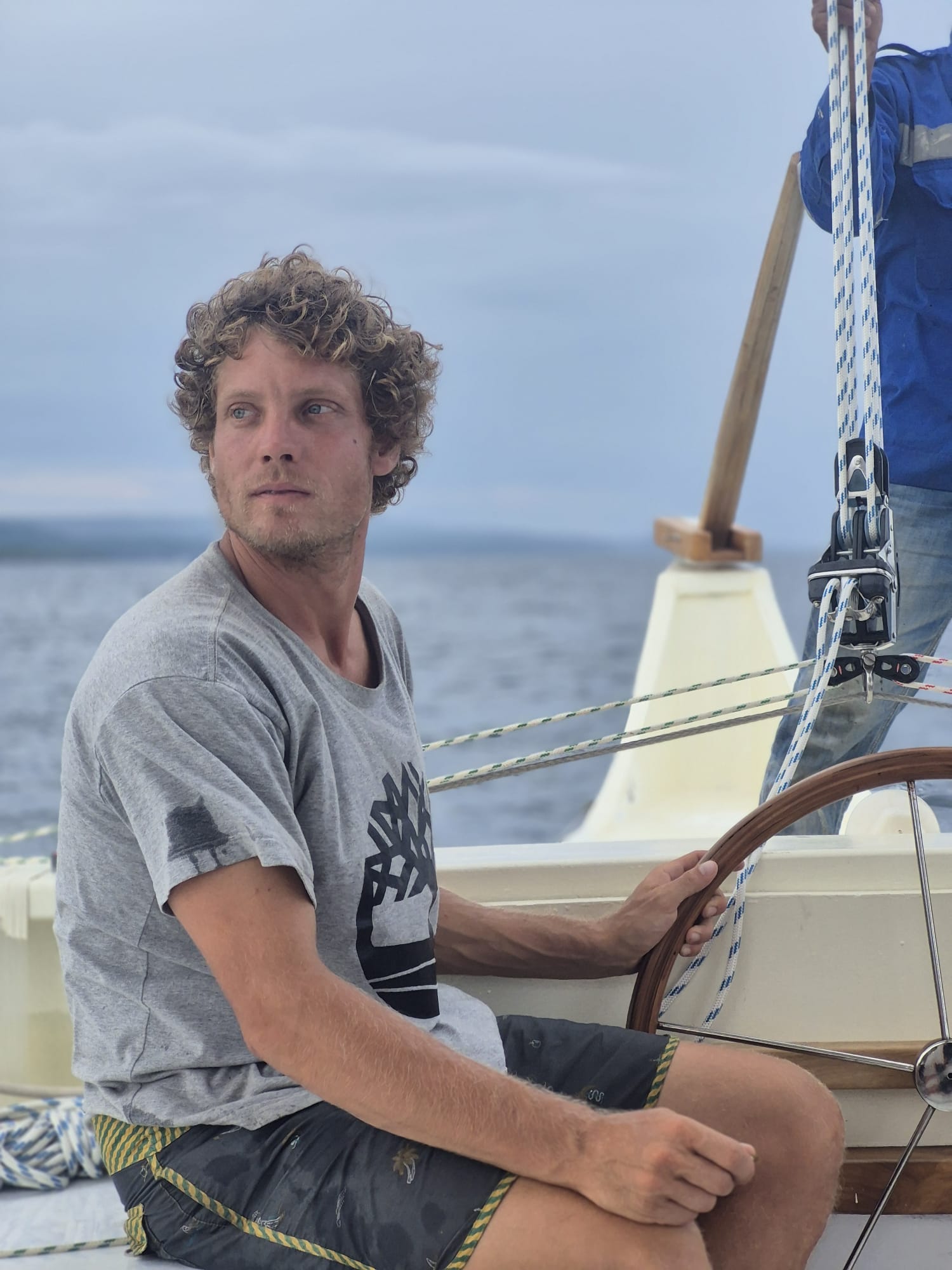
Sam has been sailing for twelve years, for the past seven as a professional skipper, delivering yachts across the Pacific, the Indian Ocean, the Red Sea, the Mediterranean and the Atlantic. Now he has one of his own.
Travelling by the power of the wind alone is one of the great achievements of humanity - the physical strength required, the ingenuity of design, the respect for the ocean, the knowledge of wind, and swell, current and tide, sun and stars.
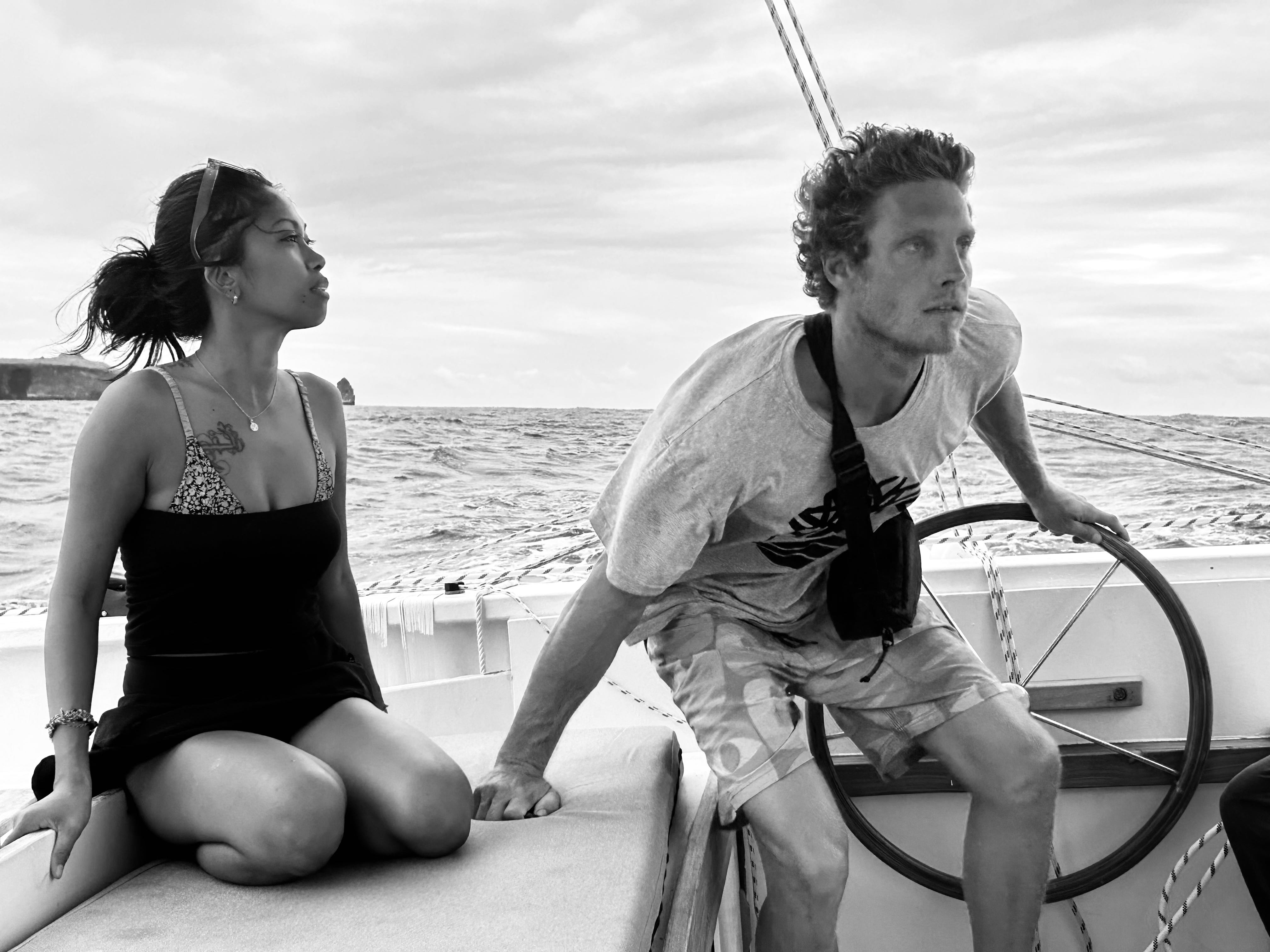
The photographs are mostly taken from our trips on Bengbeng this month, as Sam trains her crew.


I’ve interviewed many people in my time, but never my eldest son…
Nick: How do you relate to the ocean - as a surfer, and a sailor?
Sam: As a higher power.
Nick: Like a being? With a personality of its own?
Sam: Sort of. I don’t feel that it knows that I’m there. I have to play by the rules of the ocean, but the ocean doesn’t play by the rules of the sailor. It’s really powerful. People build dams and breakwaters, you can control the edges a bit, but the sea washes it all away. I remember once in Nicaragua, seeing how the ocean completely rearranged the whole bay.
Nick: When was the first time you were aware of the power of the ocean?
Sam: I think surfing. How even quite a small wave can push you down - and you just have to wait till it lets you up again. Surfing is like a meditation. The time actually riding the wave is very short, very intense. It’s like skateboarding, when you’re doing tricks. It blocks everything else out in your mind. You are just focussed on the moment, reading the wave, how it’s going to break.
Nick: Do you feel happy?
Sam: Especially afterwards. Not because anyone saw you. It’s something deep inside. The small waves are playing. The big waves are more of a fight.
Nick: Against the sea?
Sam: Rather with it, testing your strength. You ride it, or you get swallowed, and…punished. You can get scratched on a coral reef, or washed a long way, so it’s hard to get back to your position, waiting for the waves.
Nick: The first ocean crossing you did was the Atlantic, from the Cape Verde islands to Martinique…how was that?
Sailing a Swan 60 from Fiji to Tahiti, August 2025
Sam: The first week felt like it lasted forever. We left port a couple of days too early, and caught the end of a storm. Rain and big swells. The next two weeks went faster. I didn’t have a Starlink then, not much technology. We were very inexperienced, even the skipper. It was his first crossing too.
Nick: Then you stayed a year in the Dominican Republic, teaching windsurfing. When I visited you there, we spoke a lot about the ocean. You had just lost a close friend, Peter, who was swimming, and was carried out to sea on the rip tide.
Sam: It happened on a really stormy day. That proved to me how strong the ocean can be. You cannot fight a rip tide. You have to swim across it. He didn't know that.
Nick: Tell me about the Pacific.
Sam: The first journey was from Ecuador, to French Polynesia. Three weeks at sea, though we saw land - the Galapagos islands - in the distance. The Pacific was much calmer than the Atlantic, on that trip anyway. There was wind every day. No rain. We caught a lot of fish - Mahi-mahi. When we arrived on Fatu-Hiva, (southernmost of the Marquesas islands) the local football team were just returning, after winning a match on another island. It felt very good to stand on land again. Everyone was dancing and cheering, and it felt like they were celebrating us.
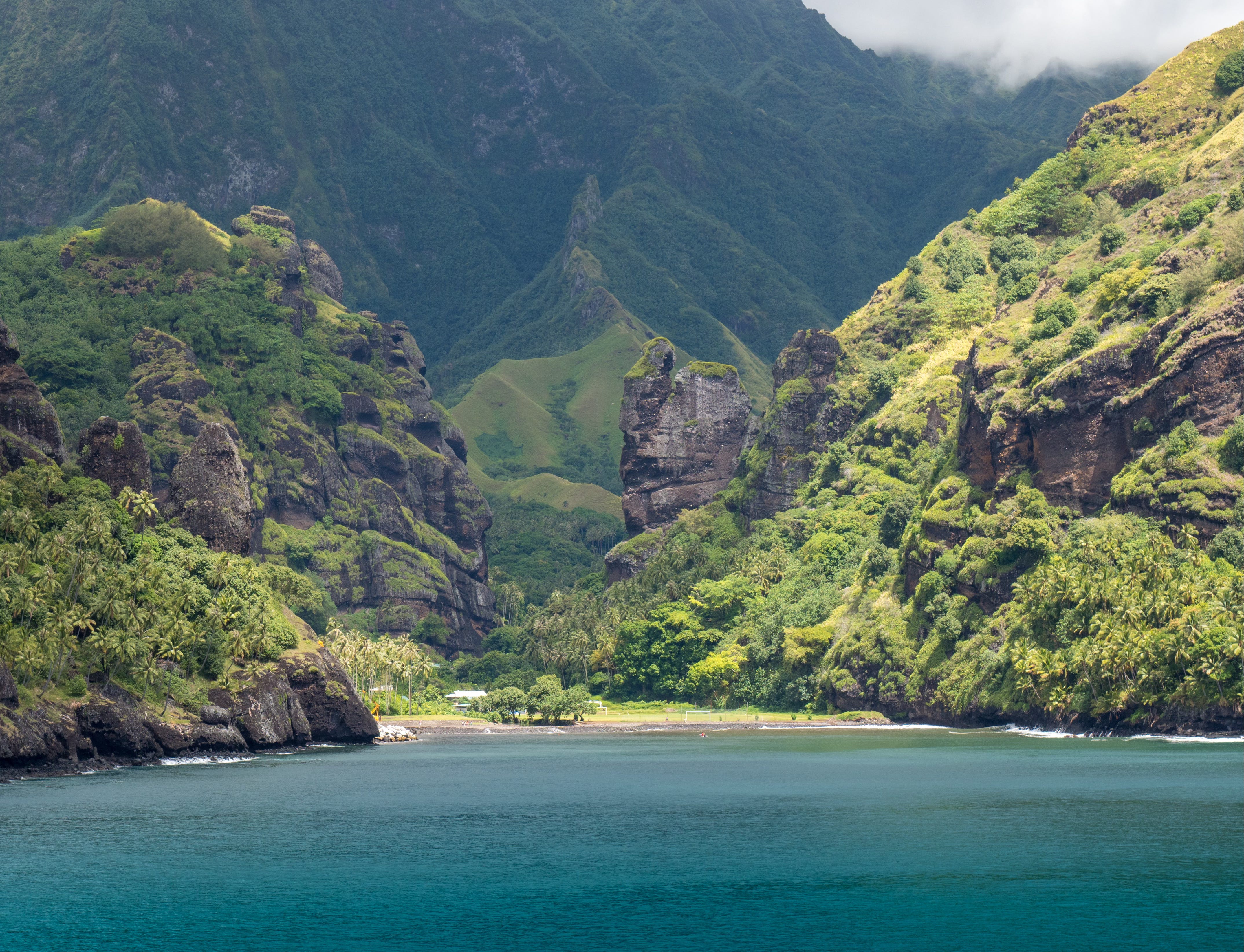
Fatu-Hiva, Monster4711 - CC: https://commons.wikimedia.org/w/index.php?curid=66005607
Polynesia has probably the most beautiful landscape I have ever seen. There are three main groups of islands. The Marquesas, the oldest high volcanic islands, with sheer cliffs rising out of the deep sea. Then the Society islands, the second youngest. Then the Tuamotu Archipelago — which are very old, eroded volcanoes which are now mostly atolls, rings of coral, around a lagoon in the middle, with hardly any land left, just a metre or two above sea level.


Nick: How did you first come to Lombok?
Sam: We were sailing past with my friend Ben, on our way to New Zealand, and anchored in Gerupuk bay. We made some good friends here. And I liked it so much, I stayed.
Nick: Just one more question. Where does the name Bengbeng come from?
Sam: Bengt was a Swedish multihull expert, who designed and started building her with Jon. Bengt passed away a few years ago, before he could finish construction. She’s named after Bengt.
So many boat projects start as dreams, and never get completed, which is kind of sad. This one was different. With Jon and Olle, we had to figure out what to do - all we had were 3 hulls and a scale model - there were no plans, but many parts.
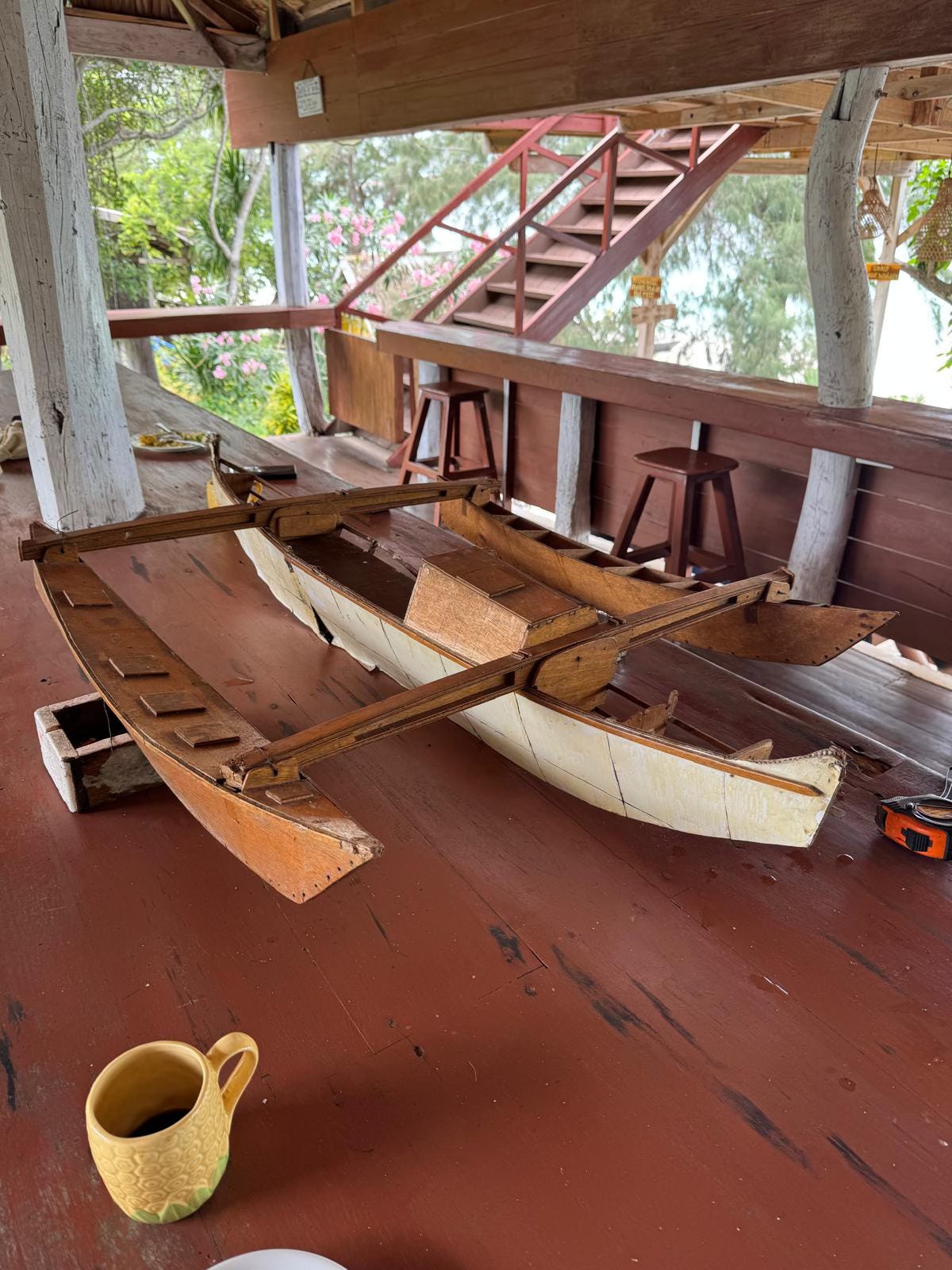
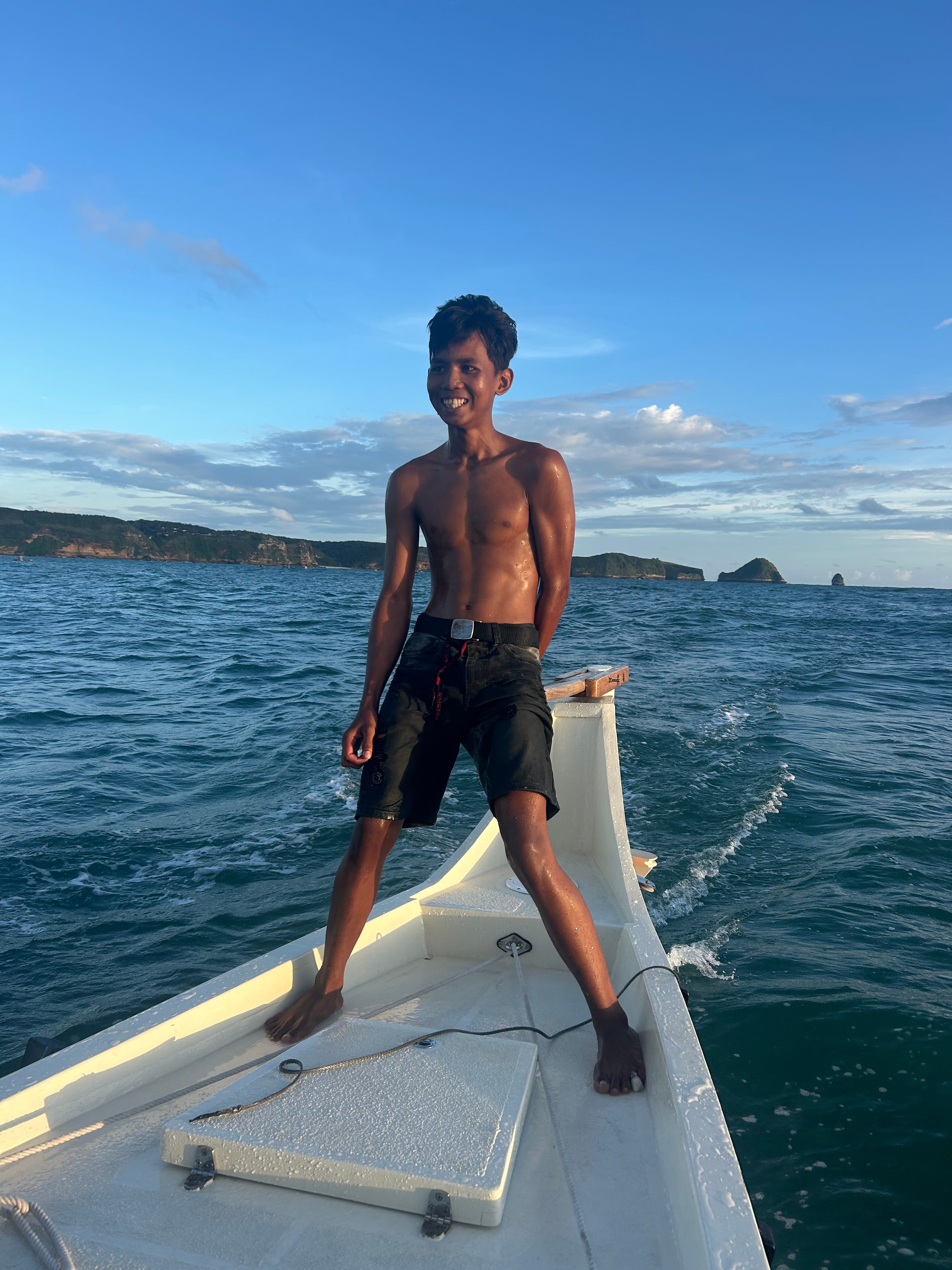
Arif is 18, a ship’s carpenter, from Arah on Sulawesi, learning to sail and master Bengbeng, while Sam’s away delivering yachts across the oceans. The villagers on Sulawesi tend to stick to their own craft - boatbuilding in one village, sailors in another. That makes Arif unusual. He crossed the line - enthusiastically.
The bay at Gerupuk is calm, with routes out between the reefs towards the spot where the big swell draws the surfers, and where you can watch the sun set over the Indian Ocean between the islands. At low tide, once a year, the locals wade far out to collect sea-slugs, a delicacy at the annual Bau Nyale festival, at the time of the February full moon.
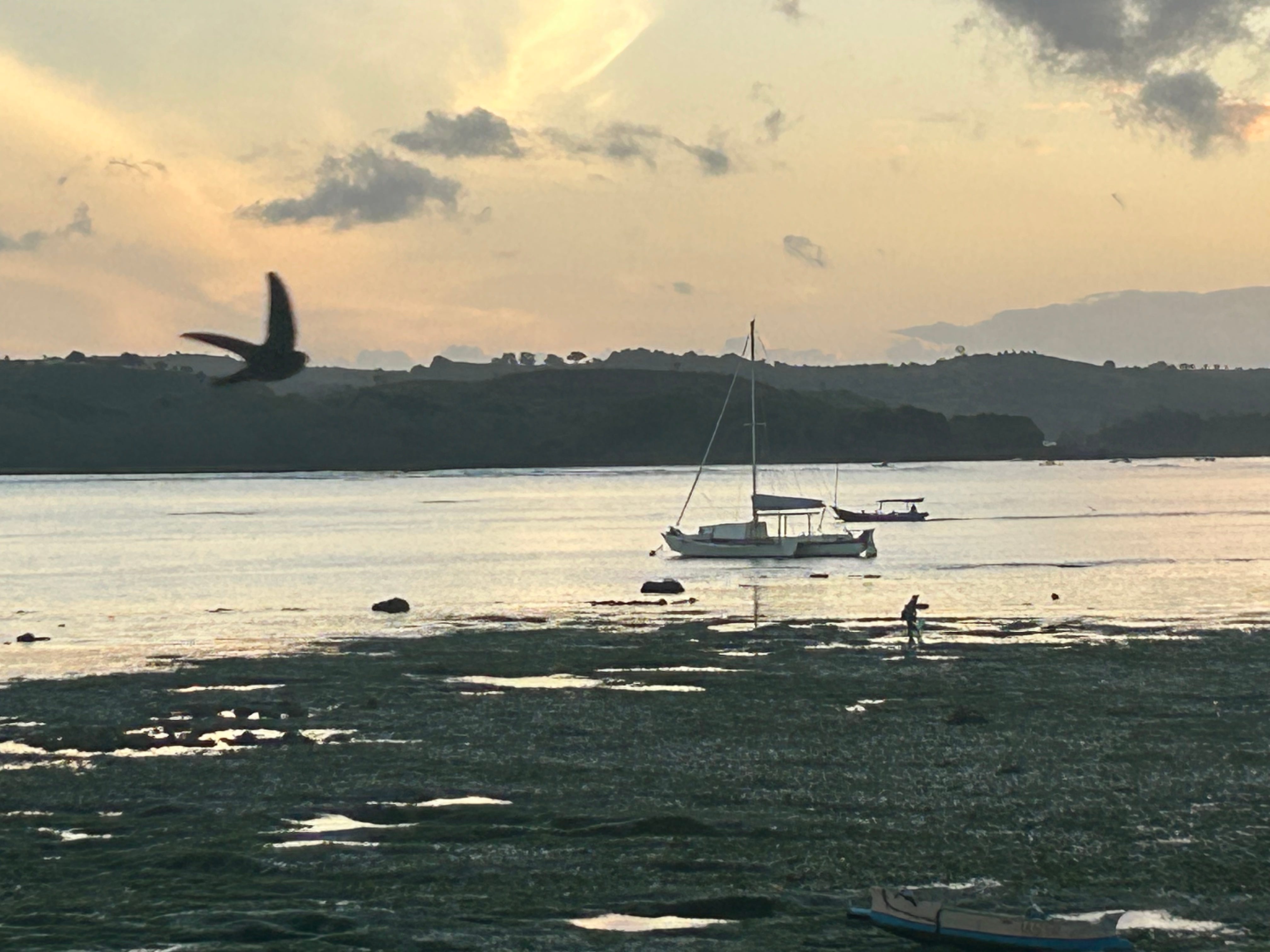
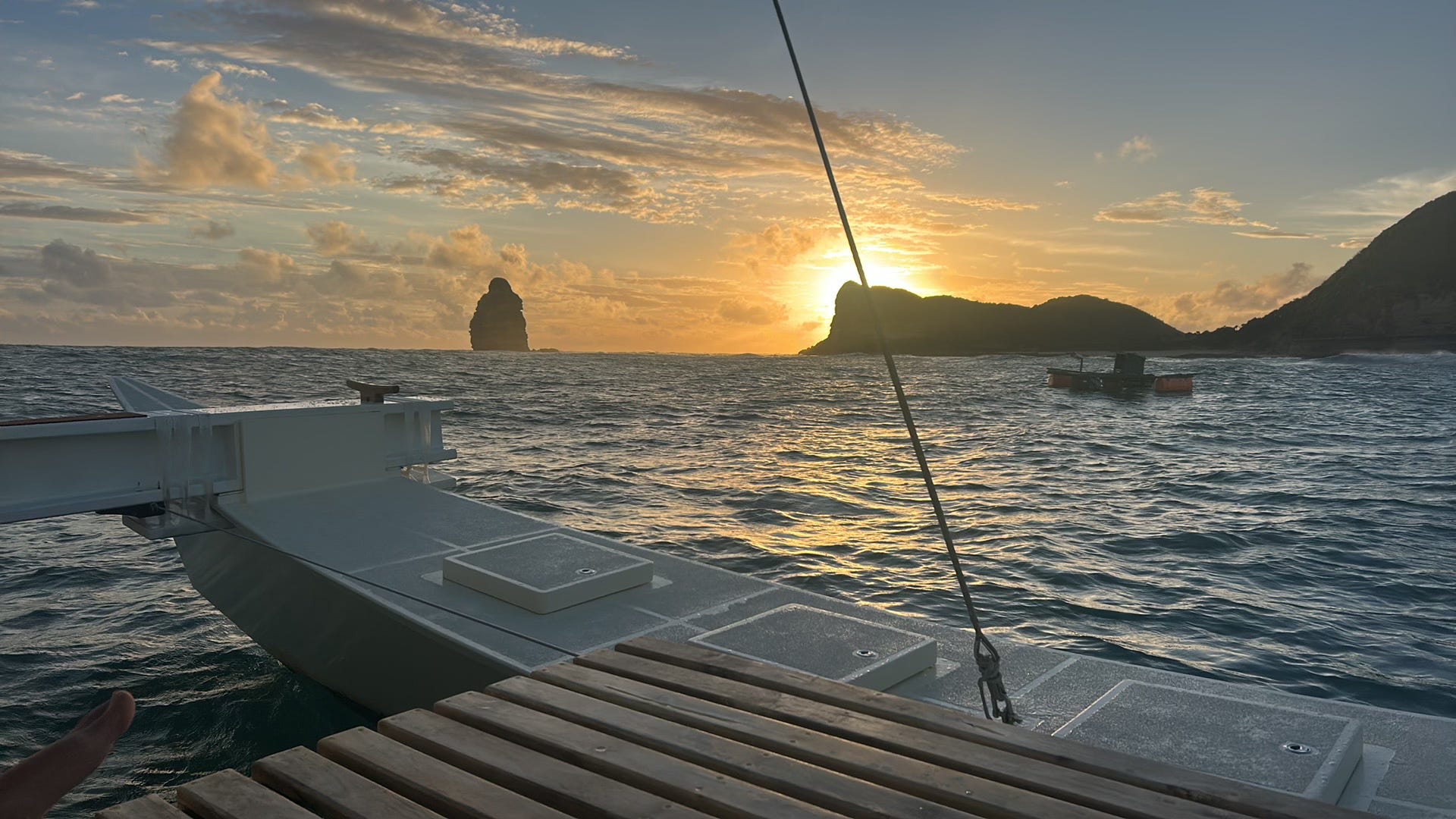


The currents are strong in the straits between Lombok and Bali, and between Borneo and Sulawesi, known as the Wallace line. Just 35 km wide, it was named in 1868 after the British naturalist Alfred Russel Wallace, who developed the theory of evolution with Charles Darwin. Wallace described the dramatic difference between the wildlife on either side of the line in his book The Malay Archipelago (1869). To the east, kangaroos, marsupials, cockatoos and birds of paradise. To the west, monkeys, woodpeckers, tigers and elephants. The reason is the sheer depth of water in the straits - over 200 metres on average, 500 metres in places, maintained by the powerful currents between the Pacific and Indian Oceans.
During the last ice age, sea levels dropped by up to 120 metres and land bridges were created, allowing many species to cross - but here it was too deep.
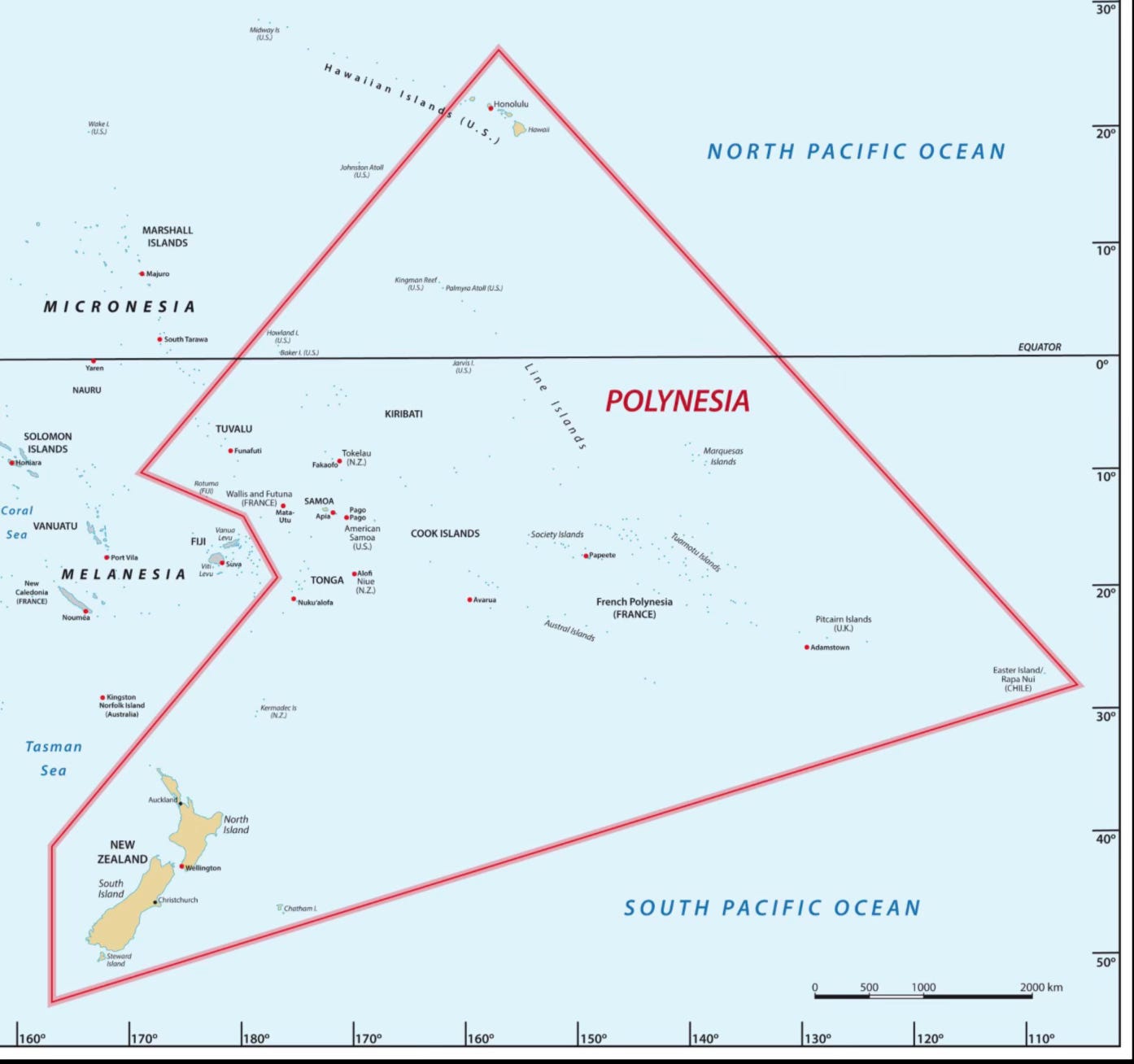
Looping east from here, north of Australia, you come out in the full Pacific. After Papua New Guinea the ocean is sparsely dotted with islands - the Carolines, Marshalls, Solomons, Vanuatu, and French Polynesia - all the way to the shores of North and South America.
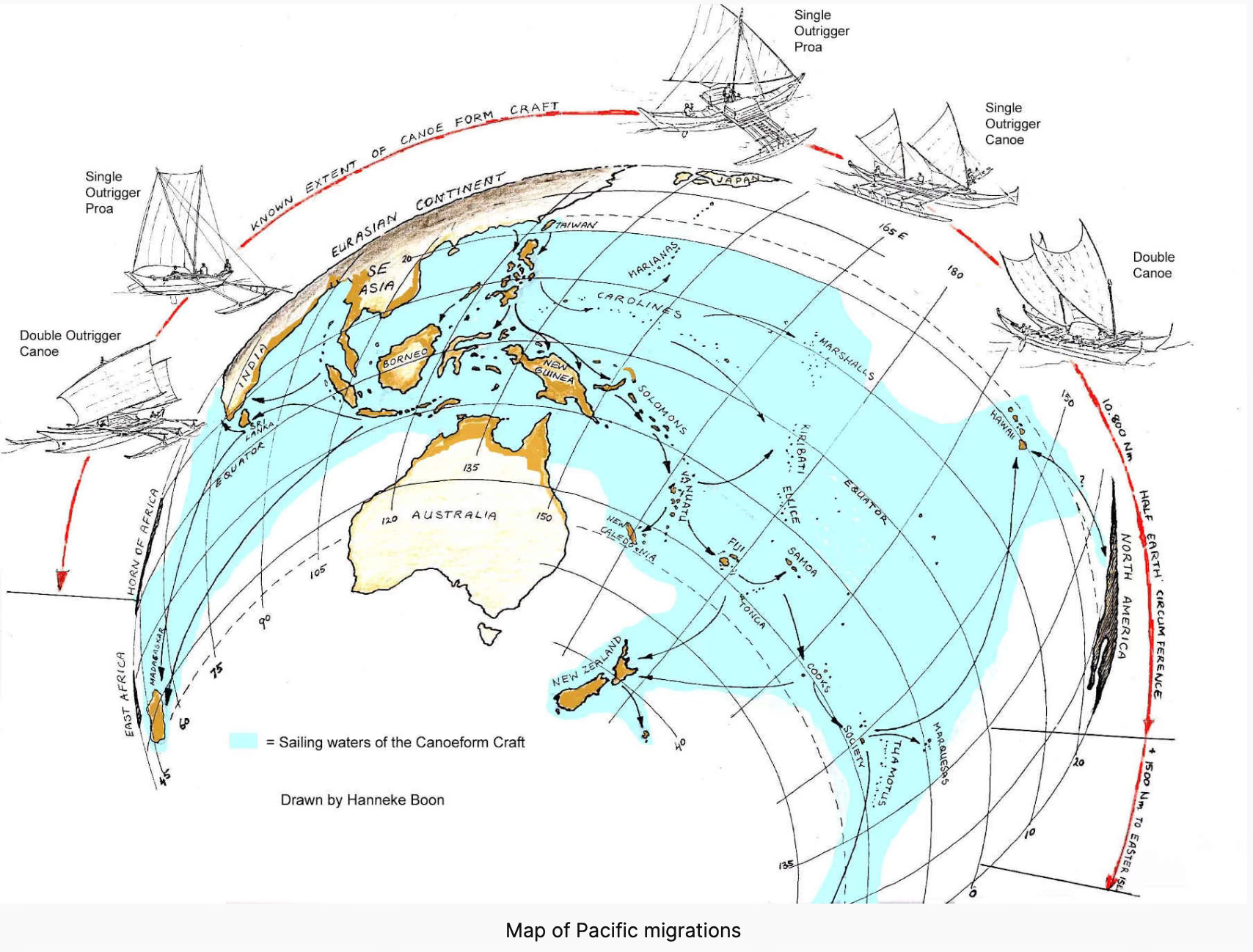
Map by Hanneke Boon, of navigation routes of sailing canoes, to accompany a discussion with James Wharram at the Royal Lymington Yacht Club, February 1998
Mau Piailug was a traditional navigator from the Carolines, enlisted by the Polynesian Voyaging Society in the crew of the Hokule’a, or “Star of Gladness” (Arcturus), a double-hulled sailing canoe to sail 2,500 miles from Hawaii to Tahiti in the spring of 1976.
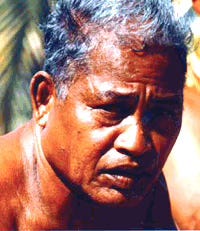
Maiden Voyage Productions - https://commons.wikimedia.org/w/index.php?curid=11567230
‘Mau was the only man who knew the ancient Polynesian art of sailing by the stars, the feel of the wind and the look of the sea.
On that month-long trip he carried no compass, sextant or charts. He was not against modern instruments on principle. A compass could occasionally be useful in daylight; and, at least in old age, he wore a chunky watch. But Mau did not operate on latitude, longitude, angles, or mathematical calculations of any kind. He walked, and sailed, under an arching web of stars moving slowly east to west from their rising to their setting points, and knew them so well—more than 100 of them by name, and their associated stars by colour, light and habit—that he seemed to hold a whole cosmos in his head, with himself, determined, stocky and unassuming, at the nub of the celestial action.’
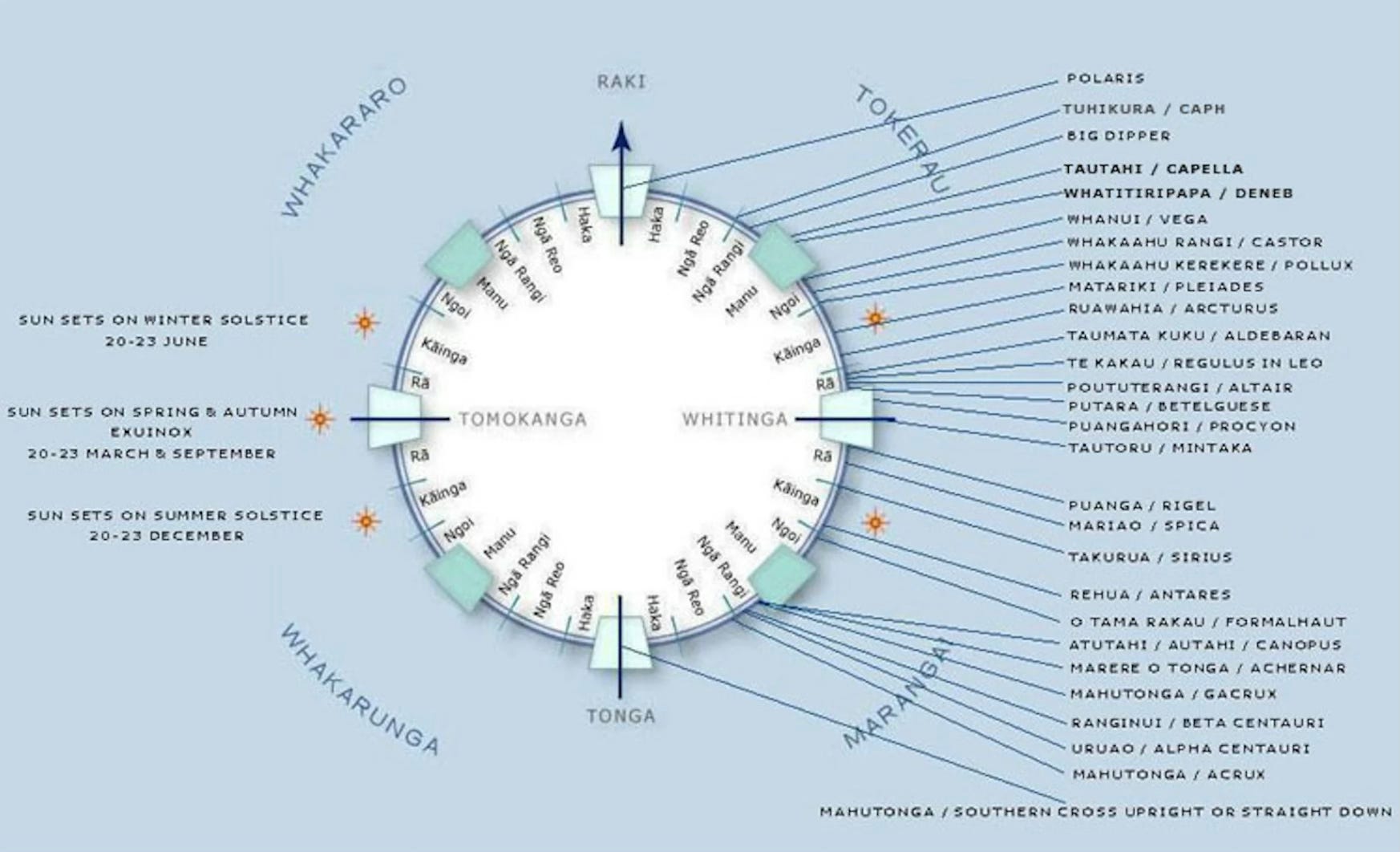
Modern-day star compass (kāpehu whetū) developed by Polynesian navigator Nainoa Thompson, based on the Micronesian star compass that Mau Piailug originally designed and used.
Setting out on an ocean voyage, with water in gourds and pounded tubers tied up in leaves, he would point his canoe into the right slant of wind, and then along a path between a rising star and an opposite, setting one. With his departure star astern and his destination star ahead, he could keep to his course. By day he was guided by the rising and setting sun but also by the ocean herself, the mother of life. He could read how far he was from shore, and its direction, by the feel of the swell against the hull. He could detect shallower water by colour, and see the light of invisible lagoons reflected in the undersides of clouds. Sweeter-tasting fish meant rivers in the offing; groups of birds, homing in the evening, showed him where land lay.
From Mau’s obituary in the Economist, 24.07.10
In his book Spice Islands Voyage (1997, Little Brown & Company), Tim Severin describes a journey in a specially built prahu, a traditional sailing canoe in the tracks of Alfred Wallace in eastern Indonesia. Leonard, the ship’s artist had already painted geckos on the sails, but that was not enough for Jimmy, the chief boat-builder.
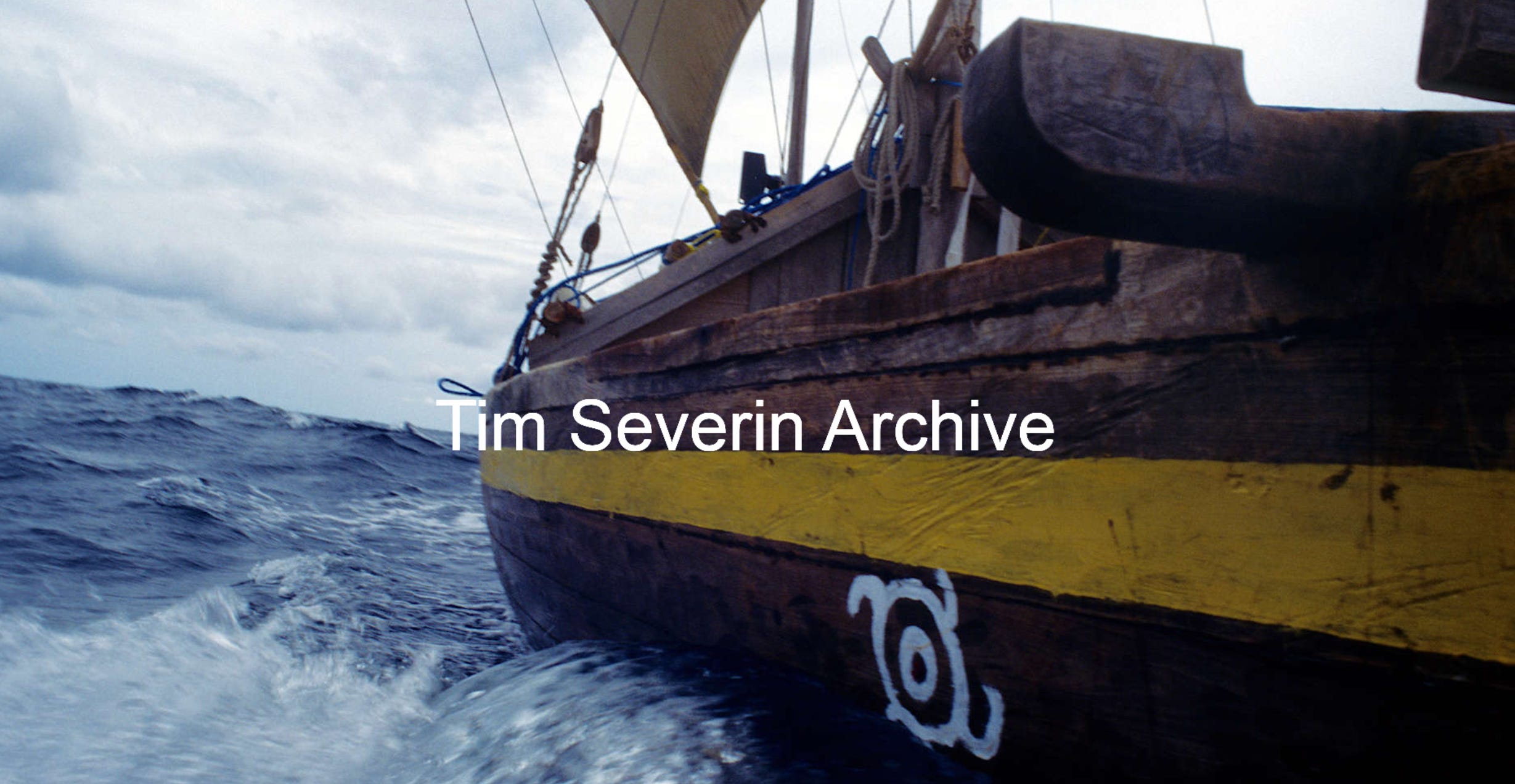
In one hand he held a tin of white paint and a small brush, in the other a bright scarlet rag and a knife. With the point of the knife he gouged a small hole in a plank just near the bow, then he produced a small gold ring and used his knife to scrape gold dust onto the scrap of cloth. He prodded the scrap of gold-dusted cloth into the little hole - this made the pupil of the ‘eye’. Then he took his paint brush and drew a white circle around the pupil, about six inches in diameter, and from it painted four radiating, curved arms. It was both an ‘eye’ and a very ancient sun symbol.
Then he painted another on the other side of the bow, to allow the boat to ‘see’ her way across the waters. During construction, he had also placed a grain of rice in the main joint of the keel, and a piece of tree root, to connect the boat with the spirits of the land, no matter how far out in the oceans.
Bengbeng, Polynesian in her own way, sailing into harbour in Lombok
‘One reason for the expense of modern yachts, multihulls or mono, is that they are increasingly designed to accommodate the body comfort and mental attitudes of soft urban Man,’ wrote James Wharram. The story of Bengbeng is a gentle push in another direction.


Beautiful stuff Nick especially when you’re talking to Sam. MI
Lovely yacht. And what a wonderfully happy picture of you at the tiller!